
An orchard from scratch / Operation Sandpit
An ongoing real-time series about helping a friend create a food forest intermixed with some unpopular takes on permaculture

If you missed the first post in the series, it’s best to go back and read it, because without context, you will have a harder time understanding the how and whys. Also, you can find the whole series at its dedicated tag page.
The previous episode took place in early and mid January 2024 and there is positive progress to show so I decided to write up the next installment!
The muddy debacle had to be solved ASAP, because trees were coming, the owner was coming and further delay was not an option. I expected until the last moment for something, anything, to go wrong.
Happily I managed to get hold of a machine operator I work with sometimes, because he has good landscaping experience, not just heavy duty excavation and earth moving. He pulled some strings so we can have what is called here “landscaping soil” delivered in bulk.
Landscaping soil is alluvial deposits removed during annual river bed mainainance operations. That is usually destructive in it’s own right, because “cleaning up” a riverbed upends the natural function of a river, but as it’s a governmental operation, you can’t really do anything about it. Besides making use of it.
I see it as a similar act to going to what in the western world is know as “the tip” and getting stuff someone threw out. Of course he didn’t have to dump it there because it’s as good as now, but as it is already done and you could have not done anything to prevent it, at least make use of the resource!
So when they scoop out sandy sediment from riverbeds here, they usually pile them up in a depot and then process them (sieving for finer fraction, removing trash, etc) and then, depending on the composition, they might add more sand to it.
Landscapers love and use that soil mix because it’s very easy to spread around and even out and grade and smooth. It’s great for starting a lawn or a decorative garden bed. It won’t hold water so much it gets boggy and anaerobic as the clay soil would if over saturated. It warms quicker and dries out quicker so your surface is not a muddy mess after a tiny big of rain, while in the same time it allows the water to quickly infiltrate deeper to the clay.
It’s not really a growing medium per se, because it’s used as a top coat - it’s applied in thin finishing layers, 5-10 thick and then whatever you’re planting in time puts its roots deeper down into the native soil.
Also, because our whole area here is on clay soils (we inhabit an ancient lake bottom which drained in the late Pliocene), this top layer of sandy soil works great by gradually being incorporated and admixed in the native soil by the soil life to result in a more porous and more suitable to growing food. Annuals feel better at their early establishment phase and perennials have less problems like root crown rot while still benefiting from the deeper layer of native clay rich soil with great waterholding capacity.
Getting to pick our battles and the compromises we make is, for me personally, the best way to express our creative will and intention. Especially true in the case of permaculture thinking and working with nature.
I’ve never been an absolutist myself and while I make a conscious effort to maximise yield with minimal imput or impact, you can be sure I’m using every reasonable option to get to a better result for the project.
In this case, the main obstacle was the money, someone had to pay for 3 loads of 20 cubic meters each, so they would be enough to cover a 700 sqm plot with 5-10 cm of varying depth sandy soil. As the owner was willing to pay the price for moving the project forward and not missing a whole year (strong time preference for that project, as anyone who’s worked with trees knows - you have to start as early as possible) + the machine operator was available right away + the soil was readily available, I took that as a good sign and went forward with the delivery.
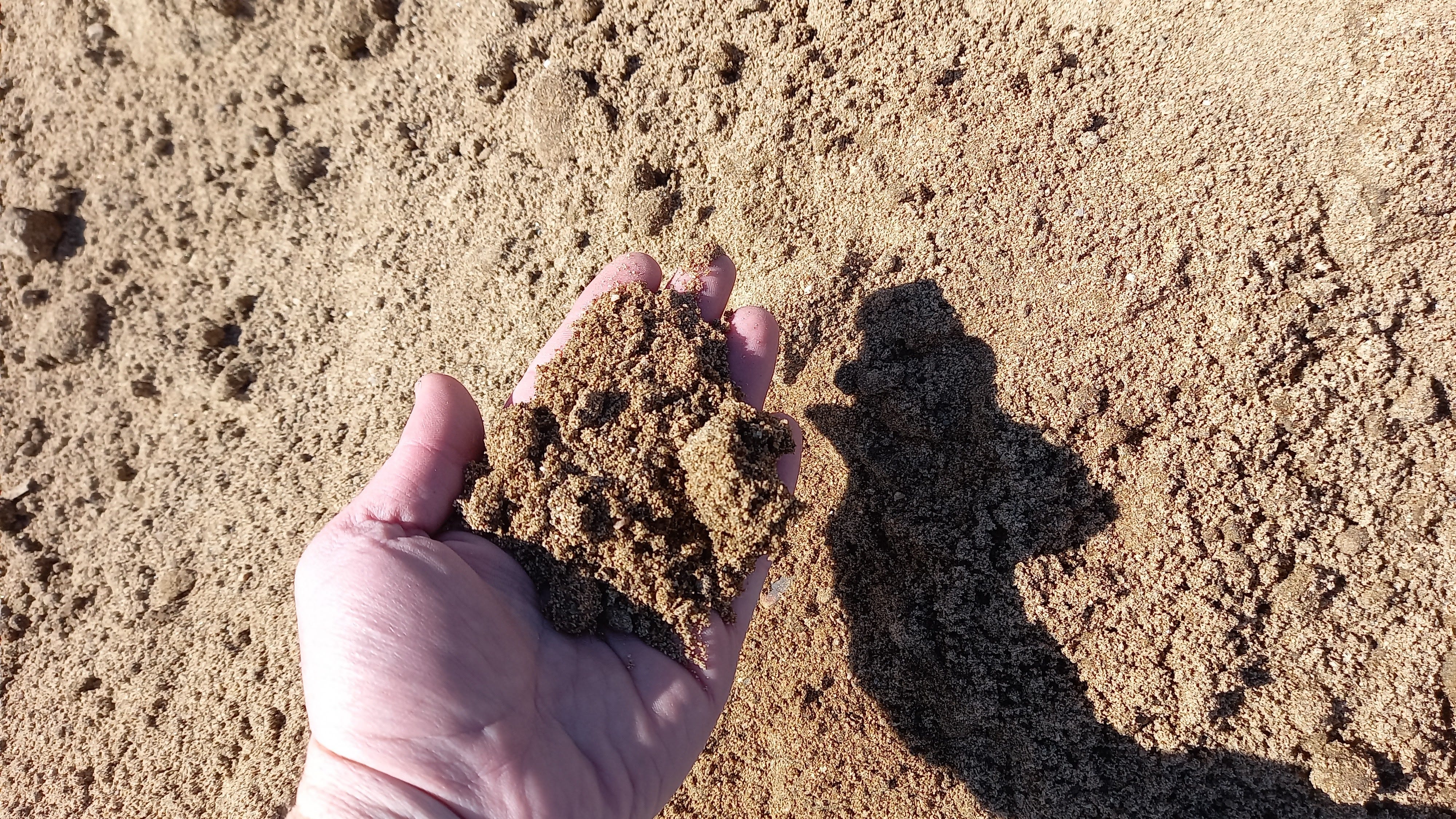
You can see in the photo above what is the nature of the delivered material. Large grain size, a good 50% sand and then mostly silt with some tiny fraction of clay.
I’m reposting the drawing of the plot from the first post, just for clarity, up is north:
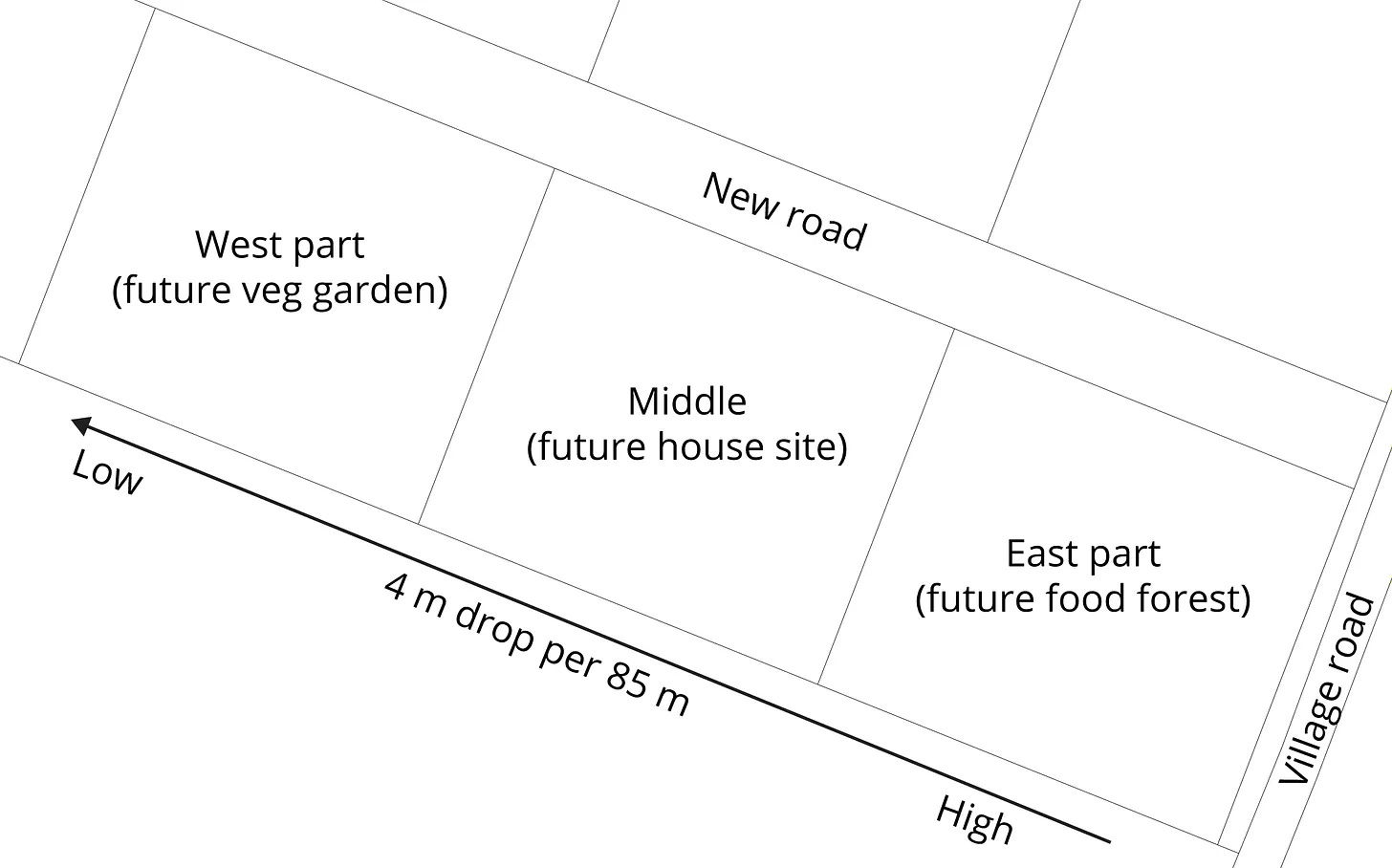
Delivery came in a couple of days, they dumped everything in the East part over the leveled vertisol, and at the very end of January, work began.
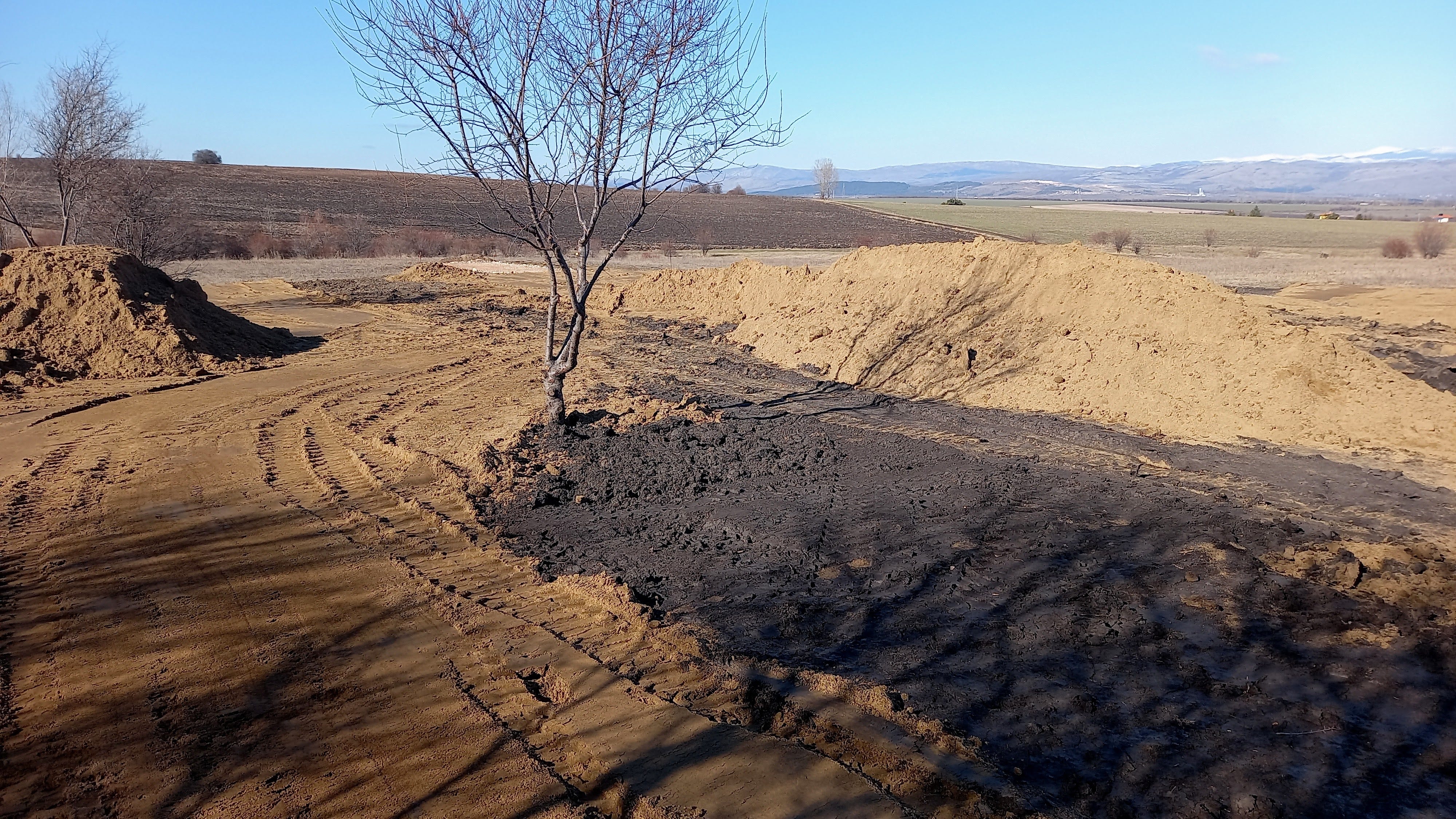
With fine material like this (fine as in no clumps and friable), work progresses very fast. A thin layer was quickly spread around to cover the clay mud and then leveling started. We aimed for the north and south sides of the plot to be a bit higher than the center (the center being where the words are on the drawing), just 15-30 cm of drop, practically invisible when you’re walking the plot, but enough to direct any rainfall towards the center and downwards. So no water is lost to the sides, basically.
In the photo below there are a few interesting details. On the far back and left side you can see how the sandy soil kinda gently ramps up at the end where the level should be a bit higher. You can also see the stark difference in color and structure of the underlying vertisol. In the center, those clumps in the new soil are river clay, which we selectively removed and will be used during planting as well. The far right to the front the height of the sandy soil seems large but it’s actually just falling over the edge there. The deepest spots I measured at 25 cm of sand, where the biggest pits were left over from the previous stage.
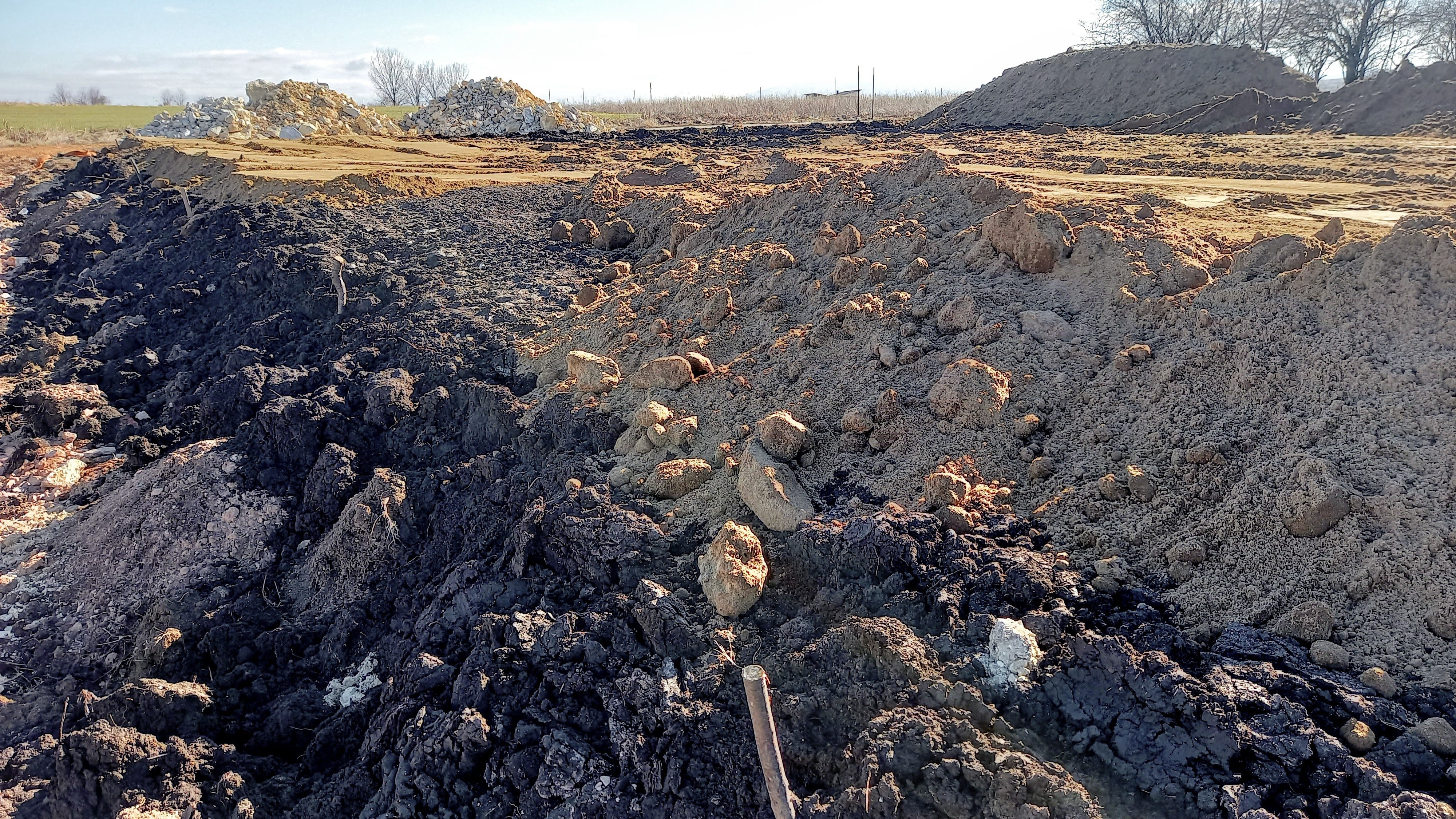
That whole edge here would be a raised fence border, but concrete works will be done next year probably, so the edges will be finished last in this plot. I plan to plant edible vines and bushes all around the food forest, so we’re looking at 100+ linear meters of space to fill in the future, hundreds of plants!
By the end of day, the work was done. Planning was good, because I needed 1-2 m3 of the sandy soil left over in a pile to use during planting and exactly that was left.
Next stage was marking the tree spots, digging the holes and then planting. That happened in less than a week later, so I’ll be posting again soon :)